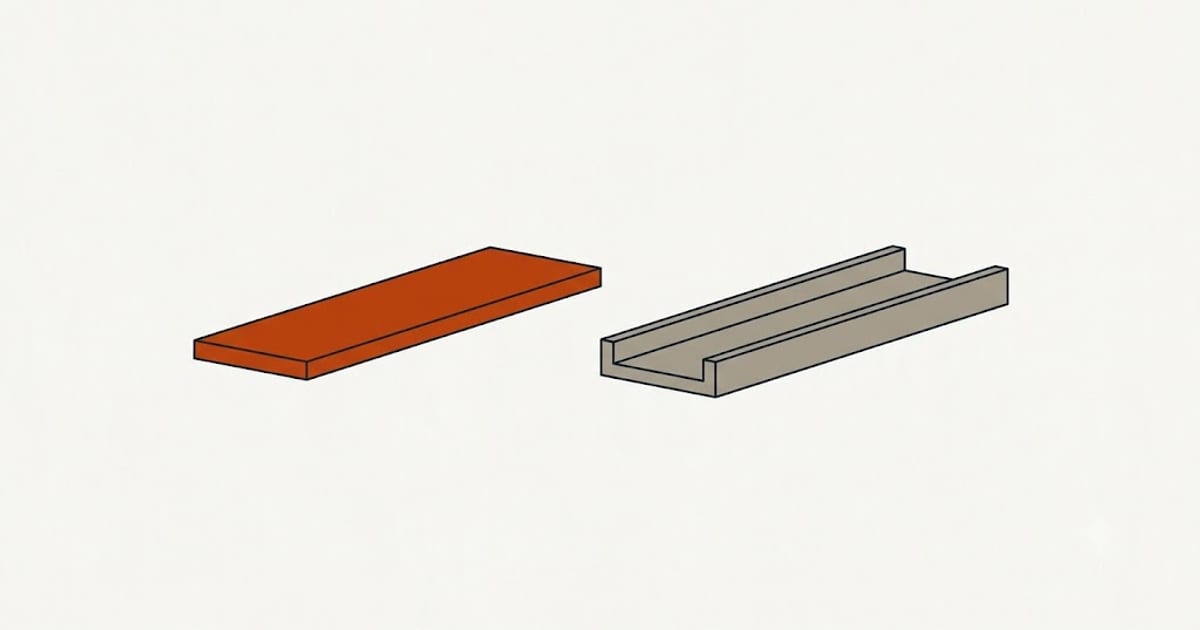
Every other material in a water loss dries by evaporation from the surface. Hardwood does that too, but most of its water is bound — held inside the cell walls rather than sitting in the pores — and bound water leaves slowly no matter how much air you move across it.
Five to fourteen days is the normal range. Two days is not a fast job; it is an unfinished one.
Why the boards cup
Wood swells across the grain as it takes on moisture. When water comes from below, the underside of each board swells while the finished top face stays comparatively dry. The board becomes wider at the bottom than the top, and the edges lift. That is cupping.
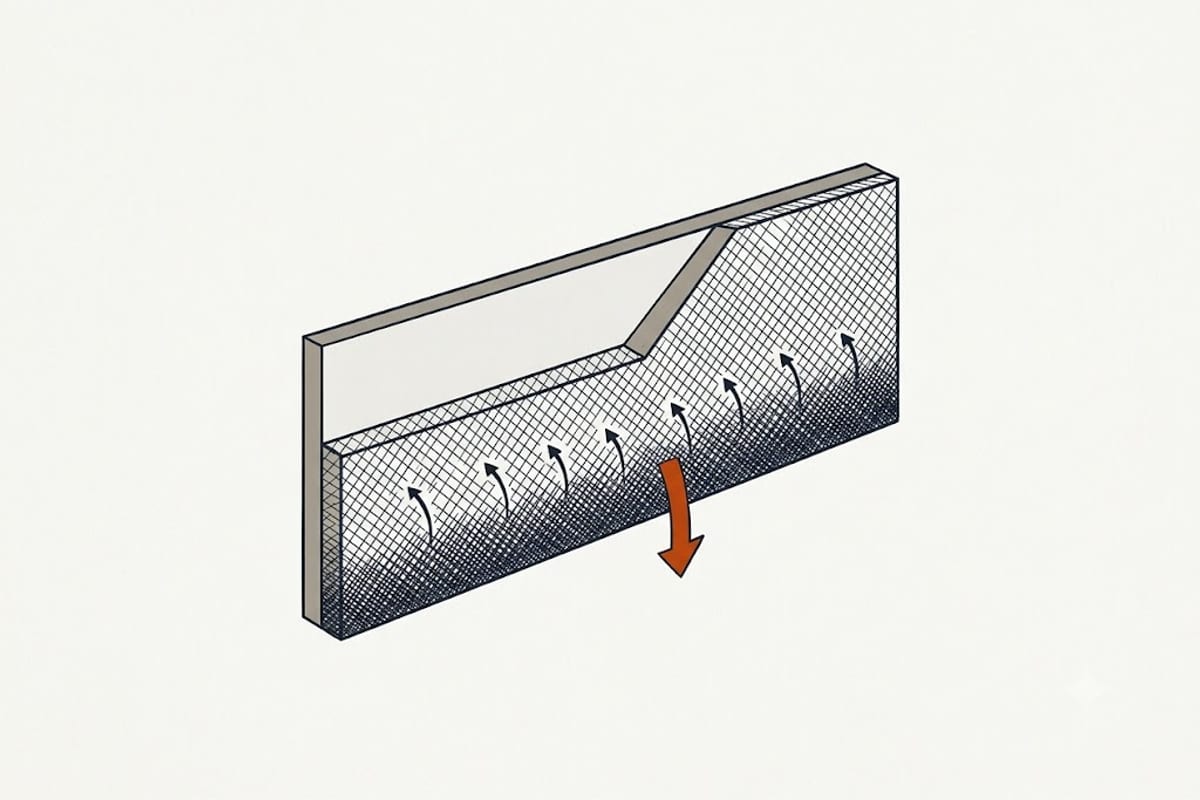
Cupping is a moisture gradient, not damage in itself. Remove the gradient and most boards flatten on their own. This is the single most important thing to understand about a wet wood floor, because it changes what you do next: the goal is to dry the whole board evenly, not to dry the surface quickly.
Dry the top face fast while the bottom stays wet and you reverse the gradient — the board goes to crowning, high in the middle, which does not recover. Sanding a floor that is still holding a gradient locks the deformation in permanently, which is why nobody should sand for at least several weeks after readings stabilize.
Why plain air movers do not work
Blowing air across a finished floor dries the finish. The finish is a vapor retarder — that is its job — so very little moisture leaves through the top face. Meanwhile the water sits between the boards and the subfloor with nowhere to go.
Effective drying pulls air through the assembly:
- Mat systems seal to the surface and pull vapor up through the board seams under negative pressure.
- Panel systems push dry air into the cavity below from an adjacent access point.
- Injection systems feed dry air into the subfloor space, used where there is a cavity to work with.
Combined with strong dehumidification, these move the bound water in days rather than months.
Target readings, not target days
The finish line is moisture content within 4 percentage points of the dry standard — measured on unaffected wood of the same species in the same building.
| Region and season | Typical dry standard |
|---|---|
| Dry southwest | 6–8% |
| Northern winter, heated | 6–9% |
| Mixed climate, most of the year | 8–10% |
| Humid southeast, summer | 10–12% |
A reading of 11% is fine in Florida in July and clearly wet in Denver in January. Any target number quoted without a reference reading is guesswork.
Use a pin meter with insulated probes set for the species. Uninsulated pins read the wettest layer they touch, which is usually the surface, and that is the layer you care about least.
When the floor cannot be saved
Some conditions do not respond regardless of method:
- Engineered flooring with a delaminated core. Once the plies separate, drying does not put them back.
- Laminate. The core is compressed fiberboard; it swells irreversibly.
- Category 3 water. Contaminated water in the seams and the subfloor cavity means removal, not drying — the standard does not permit drying contaminated porous assemblies in place.
- Boards buckled clear off the subfloor. Fasteners have failed and the assembly no longer sits flat.
What patience buys
The whole reason to run equipment for two weeks on a floor is that replacement costs several times more than drying does, and a floor that is dried correctly is usually indistinguishable afterward. Boards that look ruined at day three — visibly cupped, edges proud enough to catch a bare foot — routinely lie flat again by day ten.
The mistake that costs the floor is deciding at day three, either by tearing it out or by declaring it dry. Both happen for the same reason: someone judged a wood floor by how it looked instead of what it read.