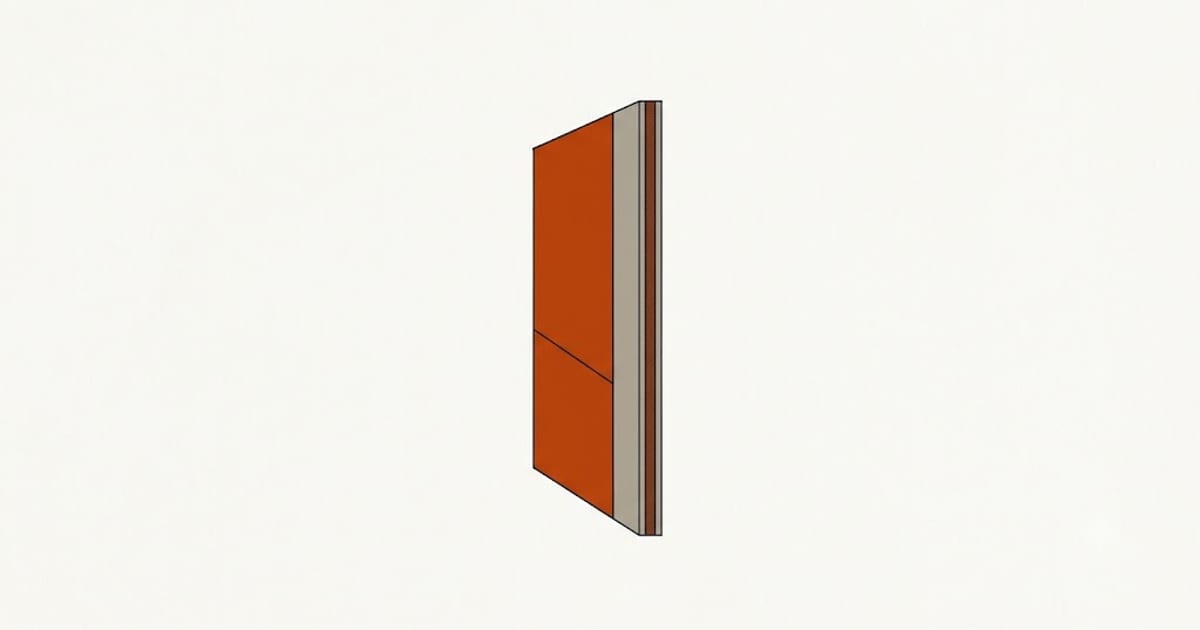
Gypsum board is paper, gypsum core, paper. The face is painted, which makes it a vapor retarder — it slows moisture moving through it in both directions. So when a wall gets wet, the painted face dries first and fastest, and it is the least important part.
The moisture that matters is in the core, in the back paper, and in whatever is in the cavity behind it.
Typical timelines
| Situation | Time to dry standard |
|---|---|
| Surface splash, wiped promptly | Hours |
| Wicked up 4–8 inches, empty cavity | 2–3 days |
| Wicked up 12–24 inches, empty cavity | 3–5 days |
| Any height, insulation wet in cavity | 5+ days, usually removal |
| Water from above through the ceiling | 4–7 days, often removal |
| Behind a vapor barrier | Will not dry — must be opened |
The pattern in that table is that the drywall itself is rarely the problem. What is behind it decides everything.
Why wicking height matters more than area
Water moves up through the gypsum core by capillary action, and it concentrates at the bottom of a wall. A wall wet across twelve feet of length but only four inches high has far less water in it than one wet across four feet at twenty inches high.
This is why restoration measures linear feet at a height rather than square feet for walls, and why the flood cut decision follows the highest reading rather than the widest one.
The three things that stall a wall
Insulation. Fiberglass in a cavity behind wet drywall holds a great deal of water and releases it very slowly through a painted face. It is the single most common reason a wall reads wet on day five with equipment running the whole time.
A vapor barrier. Poly sheeting on the warm side traps water between itself and the drywall. The assembly cannot dry inward or outward. It has to be opened.
Two layers or a wall covering. Wallpaper, vinyl wall covering, tile backer, or a second layer of board each add a barrier and roughly double the time.
What to measure and where
Take readings at the base of the wall and at intervals going up, at the same marked points each day. A pinless meter is fine for scanning to find the wet boundary; a pin meter through the back of a baseboard gives the number that goes in the log.
The reference is unaffected drywall elsewhere in the same building. Dry drywall reads very low on any meter, so the target is straightforward: back to reference, held two consecutive days.
Also check the bottom plate. It is wood, it sits at the lowest point, it dries last, and closing a wall over a wet plate is how a job comes back as odor three months later.
When to stop drying and open it
Restoration standards favor drying in place where the water is clean and the assembly can be reached. That preference ends when:
- Readings have not moved in two days with correct equipment
- Insulation in the cavity is confirmed wet
- The water was Category 2 or 3
- There is a vapor barrier
- The wall is plaster over lath, which is a different material with a different approach
Opening a cavity feels like escalation and usually shortens the job. A wall that would have taken eight days closed dries in two once air can reach both sides of it.
The honest summary
Drywall is fast. Cavities are slow. If a wall is still reading wet after three days with equipment running, the drywall is not the thing that is wet — and no amount of additional airflow across the painted face is going to reach what is.