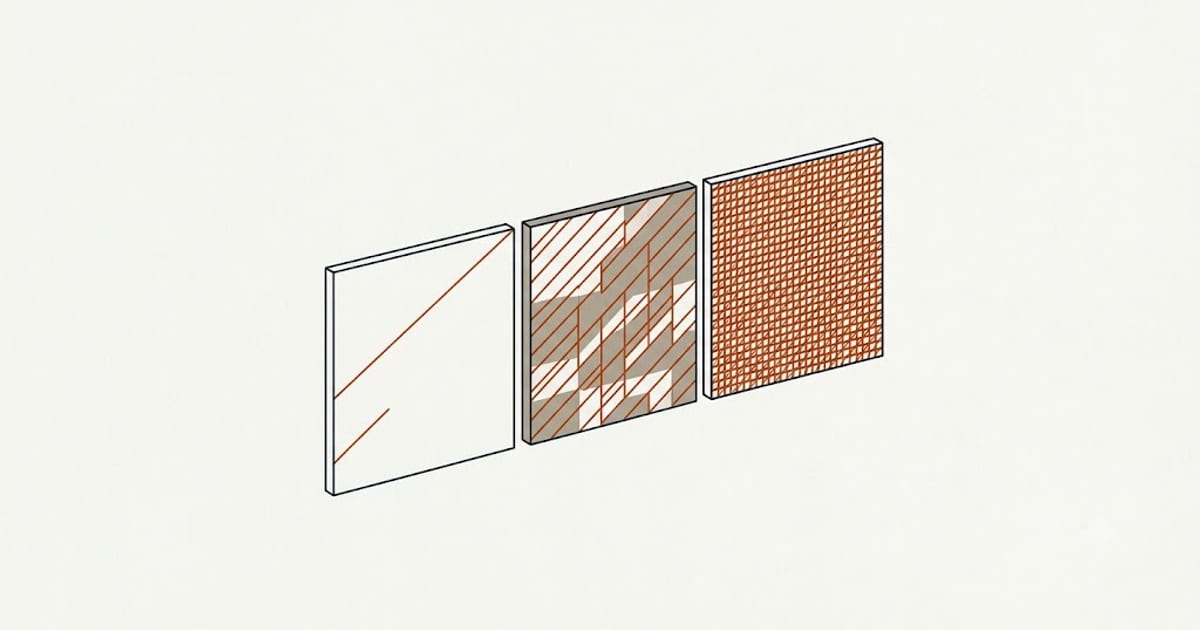
With contaminated water the decision is not "how damaged is it." It is "can this material be cleaned all the way through." That question has a physical answer, and it splits everything in a building into three groups.
Non-porous — cleaned and kept
Glass, metal, hard plastic, glazed ceramic tile, sealed concrete, solid-surface countertops. Contamination sits on the surface and nothing penetrates. These are cleaned, disinfected, and stay in the building regardless of category.
A tile floor that had sewage on it is cleaned. The grout is the question, not the tile.
Semi-porous — judged individually
Wood framing, plywood, OSB, unsealed concrete, brick. These absorb somewhat but can often be cleaned, treated, and dried successfully because the structure is dense and the contamination does not penetrate deeply.
Framing lumber is nearly always saved. It is cleaned, treated with an antimicrobial, dried to the standard, and stays — because replacing structure is a different order of work and it is rarely necessary.
Subfloor is the judgment call. Plywood usually survives; OSB frequently does not, because it swells at the edges and delaminates once wet.
Porous — removed
Carpet, carpet pad, insulation, drywall, particle board, MDF, upholstered furniture, mattresses, ceiling tile, laminate flooring. These absorb contamination into a structure that cannot be cleaned through, and no surface treatment reaches the inside.
The hardest part of this for homeowners is that condition is irrelevant. A nearly new carpet that looks untouched still goes, because the contamination is in the backing and the pad beneath it.
The reasoning
Cleaning removes what it can reach. In a porous material the contamination is distributed through a structure that is mostly void space, and disinfectant applied to the surface does not reach it. Drying such a material leaves the contamination in place — dry contamination rather than wet, which is not the goal.
This is why standards do not permit drying contaminated porous material in place. It is not conservatism; it is that the process does not work.
Contents, which follow different rules
Usually saved: hard furniture, dishes, glass, metal, sealed wood, electronics that stayed dry, photographs if handled early.
Usually lost: upholstered furniture, mattresses, particle board furniture, anything with a paper or fabric core, food, cosmetics, medicine.
Specialty cleaning: clothing and linens through commercial laundering, some documents through freeze drying, some artwork by conservators.
A furniture piece with a solid wood frame and replaceable upholstery is often worth saving. Anything with a particle board carcass is not, because the core swells and cannot be cleaned.
Where arguments happen
Three items generate most of the disagreement:
Hardwood flooring. Category 3 water in the seams and the cavity below is nearly always removal. Owners resist because the floor looks salvageable and often expensive. The contamination is under it.
Cabinets. The boxes are usually particle board even when the doors are solid wood. If contaminated water reached the toe kick and the interior, the boxes go and the doors sometimes stay.
Recently replaced anything. Age does not change porosity, and this is the hardest conversation in the trade.
What to expect in the scope
A Category 3 scope should read as a materials list, not as a damage assessment. If it justifies removal by describing how bad something looks rather than what the material is, the reasoning is wrong even where the conclusion happens to be right.
Documenting what leaves the building
Every item removed on a contaminated loss should be recorded before it goes into a bag. Photographs of the item in place, a written inventory with quantities, and a note of why it was classified as unsalvageable. This is not bureaucracy — it is the only record that will exist afterward, and both the insurer and the homeowner are entitled to see it.
The practical reason is that disposal is irreversible. Once a carpet is in a dumpster, a disagreement about whether it needed to go there cannot be settled by looking at it. A scope that lists quantities without photographs is asking to be trusted about the largest and least reversible part of the work.
Contents get the same treatment, itemized separately from building materials, because they are usually covered under a different part of the policy with its own limits. Bundling a homeowner's furniture into a demolition line is a common way for a claim to be underpaid without anyone noticing.
The one exception worth knowing
Structural wood that has begun to rot is neither cleaned nor simply removed — it is a structural repair, and it belongs to a carpenter rather than a remediation crew. Rot means the material has lost strength, and strength is not restored by drying or treating. Soft wood at a sill plate or a joist end should move the conversation from restoration to repair, and it should do so before anything is closed up.