Air movers and dehumidifiers are usually bought as a set, and that is the first thing to unlearn. Air movers push water out of materials and into the air. Dehumidifiers pull it back out of the air. Those are separate loads, and they scale off different numbers.
Air mover count comes from affected surface area. Dehumidifier capacity comes from room volume and how much water has to evaporate.
The volume method
The working figure in restoration is the pint-per-day rating measured under AHAM conditions (80°F, 60% RH). Divide the room volume by a factor set by the class of loss:
| Class | What it means | Cubic feet per AHAM pint |
|---|---|---|
| Class 1 | Under 5% of the room wet, low-porosity materials | 100 |
| Class 2 | Most of the room, carpet and pad, wicking under 24 inches | 40 |
| Class 3 | Water from overhead — ceilings, walls, insulation all wet | 30 |
| Class 4 | Bound water in hardwood, plaster, concrete, masonry | 40, plus specialty drying |
A 20 × 15 room with 8-foot ceilings is 2,400 cubic feet. As a Class 2 loss that is 2,400 ÷ 40 = 60 AHAM pints. One 70-pint LGR unit covers it with margin; two 30-pint consumer units do not, and the reason is in the next section.
Why the rating on the box overstates the machine
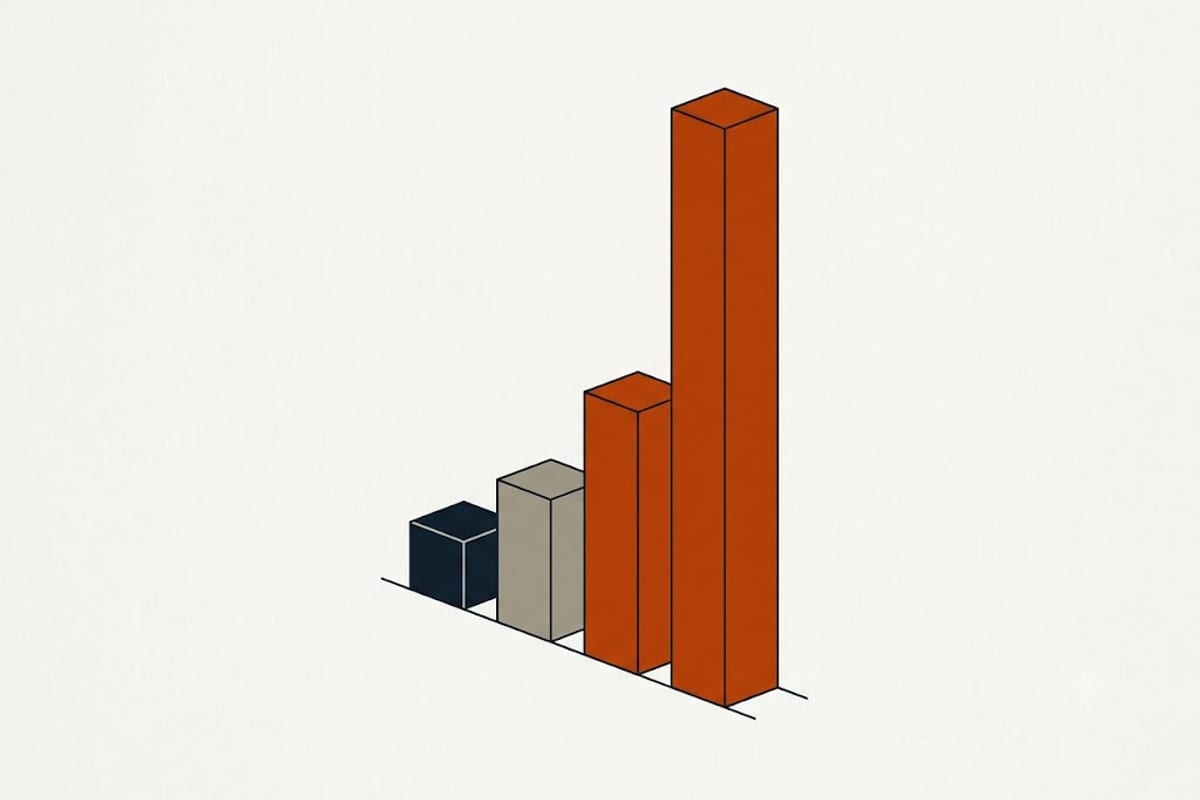
AHAM conditions are warm and humid — 80°F and 60% RH. That is the start of a drying job, not the middle of one. Once the room reaches 40% RH, a conventional refrigerant dehumidifier's output collapses, because there is less moisture in each pass of air and the coil is closer to freezing.
A low grain refrigerant (LGR) unit pre-cools the incoming air, so it keeps pulling water down to much lower humidity. That is the whole difference, and it is why restoration crews use LGR machines rather than the units sold for damp basements.
Practically: a consumer 50-pint unit that is honest at 80/60 might deliver 15 pints at 70°F and 40% RH. An LGR of the same nameplate is still doing 30 or more. Sizing off the box number and then using a consumer machine is how a job stalls at day six.
The ratio to air movers is not fixed
A rough field ratio is one dehumidifier per three to five air movers, but it drifts with the class:
- Class 1 — few air movers, and the dehumidifier is usually the limiting piece
- Class 2 — the ratio holds near 1:4
- Class 3 — more air movers per square foot because walls and ceilings are wet, so the ratio widens toward 1:5 or 1:6 of capacity
- Class 4 — air movers barely matter; the water is bound, and drying comes from vapor pressure differential and time
If you add air movers without adding capacity, the room's humidity rises, evaporation slows, and you have spent electricity to move wet air around. That shows up as a job where the moisture meter stops improving on day three.
Open the windows or not
Almost always not. Outdoor air helps only when its dew point is well below indoor dew point — not when it merely feels dry. On a 75°F day at 60% RH the outdoor dew point is around 60°F; bringing that air into a room you are trying to hold at a 45°F dew point makes the machine's job worse.
The check is one number: compare outdoor dew point to indoor dew point. Below by 10°F or more, ventilation helps. Otherwise close the space and let the equipment work.
What to actually measure
Capacity math gets you the starting equipment. What tells you whether it is enough is the trend:
- GPP (grains per pound) in the affected room versus an unaffected room. The gap is what the dehumidifier is fighting.
- Dew point at the dehumidifier's outlet. A working LGR should be putting out air 20°F drier than it takes in.
- Moisture content of the wet materials, on the same spot every day.
If GPP in the wet room is not falling day over day, capacity is short — regardless of what the volume math said.
The short version
Size dehumidifiers from room volume and class, not from air mover count. Use the AHAM number only to compare machines, not to predict field output. And if the daily readings flatten, add capacity before adding airflow — moving air that has nowhere to dump its moisture is the most common way a three-day job becomes a seven-day one.