Two entirely different machines get called dehumidifiers, and they fail in different places.
A refrigerant unit pulls air across a cold coil, condenses water out of it, and drains the liquid. A desiccant unit passes air over a moisture-adsorbing wheel, then heats a separate airstream to drive that moisture off and exhaust it outside.
The distinction matters because of one variable: temperature.
Where refrigerant machines stop working
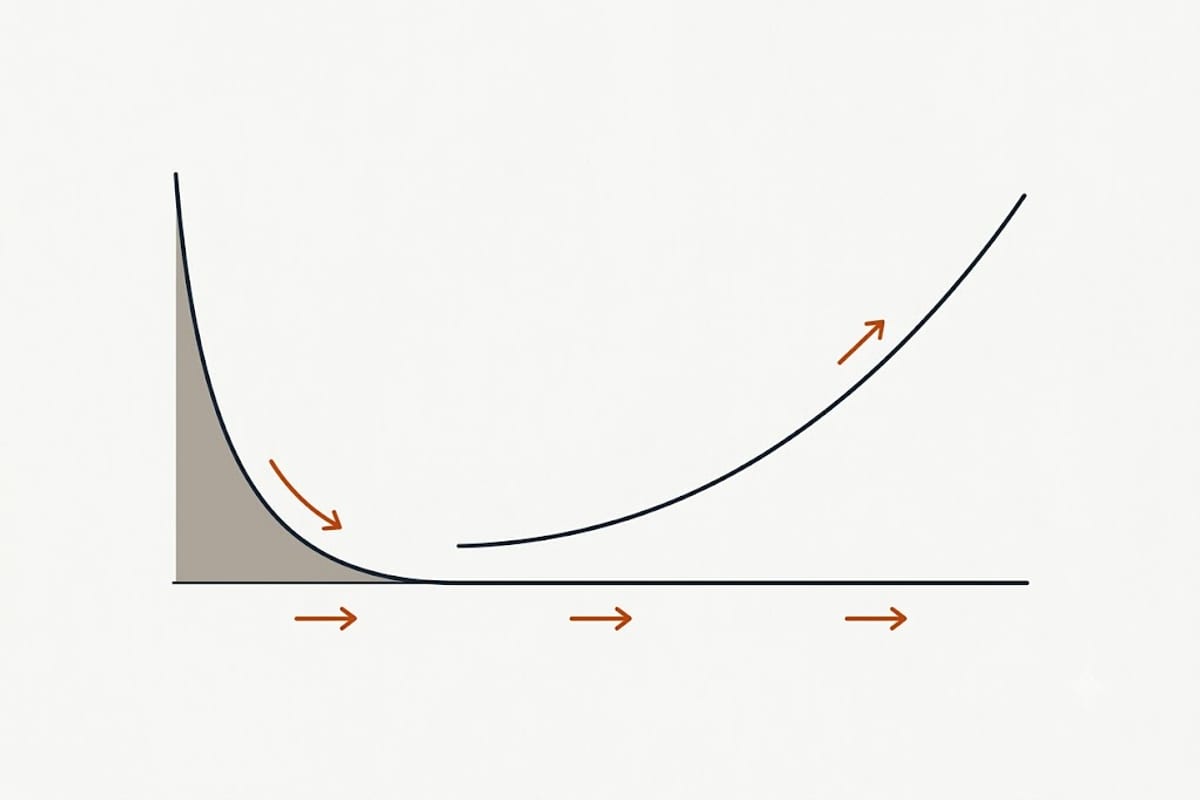
Condensation requires the coil to be below the dew point of the incoming air. As a room gets colder and drier, that dew point falls, and eventually the coil would have to run below freezing to collect anything. At that point the unit ices up, goes into defrost, and spends much of its cycle producing nothing.
In practice:
| Room condition | Refrigerant output | Desiccant output |
|---|---|---|
| 80°F, 60% RH | Full nameplate | Full |
| 70°F, 45% RH | Roughly half | Full |
| 60°F, 40% RH | A fraction | Full |
| 45°F, 40% RH | Near zero | Full |
Desiccants do not depend on condensation at all, so their output holds almost flat across that range. They are also the only practical option for pushing a space to very low humidity, which is what Class 4 materials need.
LGR sits between them
A low grain refrigerant unit pre-cools incoming air with the outgoing cold air before it reaches the coil. That extends its useful range well below a conventional refrigerant machine — down to roughly 30 grains per pound — and it is why LGR is the default in restoration rather than the units sold for damp basements.
For most losses in a heated building, LGR is the right machine. Desiccants come out when the space is cold, when the target humidity is very low, or when the material is Class 4.
What desiccants demand in return
They are not simply better. Three real costs:
They must be ducted. The regeneration airstream carries the moisture, and it has to go outside. That means a hose or duct through a window or door, sealed, on every job.
They add heat. The regeneration process puts significant heat into the space — often raising it 10 to 20°F. Sometimes useful in a cold basement, a problem in an occupied house in summer.
They use more electricity. Considerably more per pint removed than an LGR under warm conditions. Under cold conditions the comparison reverses, because the LGR is removing almost nothing.
Choosing in the field
- Heated building, 70°F and up, Class 1 to 3 — LGR, sized by volume and class
- Unheated basement or garage in winter — heat the space and use LGR, or bring a desiccant
- Hardwood, plaster, concrete, masonry — desiccant, because the target humidity is below what a refrigerant will reach
- Large open commercial space — desiccant, ducted, usually with supplemental air movement
The mistake that costs a week
Setting three LGR units in a 55°F basement and waiting. The nameplate says 210 pints; the actual output is a small fraction of that, the readings barely move, and by day four the diagnosis is "this is a difficult job."
It is not a difficult job. It is the wrong machine for the temperature, and the fix is either heat or a different machine — both of which work within hours rather than days.
Check the room temperature before deciding anything about capacity. Below 65°F, capacity math is the wrong conversation.
Reading the machine instead of the label
Nameplate pints are measured under AHAM conditions — 80°F and 60% relative humidity — which describe the first hours of a job and almost nothing after that. Two checks tell you what a unit is actually doing right now.
Grain depression. Measure the air going in and the air coming out. A working LGR should be dropping the moisture content of that airstream by a wide margin, typically 30 grains per pound or more. A conventional refrigerant unit in a cool room often shows a depression close to zero, which is the whole diagnosis in a single reading.
The drain. A machine removing water produces water. A hose that stays dry for an hour in a room that is still wet is telling you the coil is not condensing, no matter what the display says.
Both checks take two minutes and both are more informative than any calculation done before the equipment arrived. Capacity math chooses what to bring; these readings tell you whether what you brought is working.
Running two types together
On larger losses it is common to run both, and the reason is staging rather than redundancy. Early in a job the space is warm and very humid, and refrigerant units are at their most efficient — that is when they do the bulk of the water removal cheaply.
Later, once the easy water is gone and the target is a low humidity that pulls bound water out of wood and plaster, the refrigerant units lose their edge and the desiccant carries the last stretch. Switching machines partway through a job is normal practice, not an admission that the first setup was wrong.